Last Christmas I was lucky enough to be gifted something utterly
glorious by one of my oldest, kindest friends, National Trust membership.
Ever
since we have endeavoured to visit as many places as possible, and I’m
always on the look out for anywhere in striking distance that poses a
potential day out. Looking through the guide book I spotted something
which looked incredibly appealing; Wightwick Manor and as soon as I
read the words ‘Pre-Raphaelite Art Collection’ I knew it was a must.
As soon
as I walked around the exterior I immediately knew this was it; my favourite
property to date. I felt something deep within me stir. The exterior was yet another example of Victorian
perfection. With its Tudoresque timbered structure marrying brick,
wood and render in perfect harmony. The details across the exterior were
nothing short of perfection. Exquisite brick chimneys dotted the roof line adding splashes of red amongst the black and white and complimenting the block base. The once jet black fumed oak now aged hint of brown and silver with time, twisting and turning forming almost mesmerizing patterns against the white lime render. Intricate carvings lurk here and there, faces looking for a viewer, barge boards with impossibly delicate detailing and layered window frames nothing short of exquisite.
The house was no vast mansion, no lavish pile, but its aesthetics were what I consider the pinnacle of British architecture and style. In that uniquely Victorian way the Manor marries the medieval, Gothic and Tudor in a way which is utterly believable, totally respectful and considered and entirely perfect.
Once inside it felt as if someone had looked deep within me and created my ultimate Pre-Raphaelite dream. The interior felt dark and gloomy, with an incredible atmosphere that weighed heavy. The lower ceilings of the the entrance hall, study and corridors gave the building a cosy feeling which I felt was utterly unique of any building this size I'd ever visited. The endless wealth of textiles, Morris wallpaper, rugs, paintings, stained glass and so many beautiful objects gave the Manor a homely feeling which instantly warmed my heart. It's eclectic nature struck a chord with my own excessive, magpiesque traits and indulged them to the nth degree.
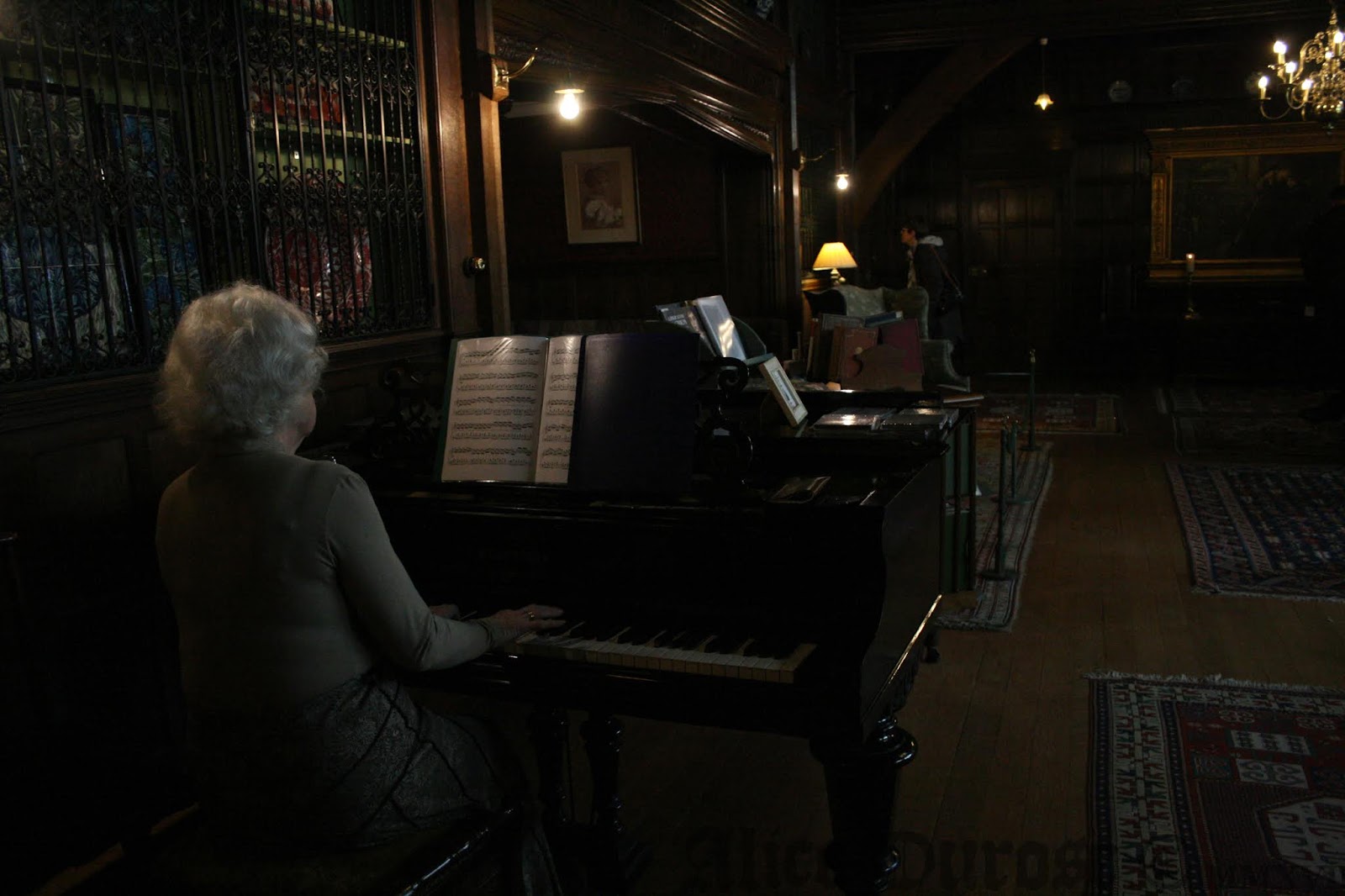
The entire Manor was a feast for the senses from beginning to end. Dante Gabriel Rosetti paintings and drawings hang here and there, above piano's, in dark hidden corners, against deep wood panelling which only serve to accentuate the decadent nature of this glorious place. I wander down the dull corridor and beams of light strike out at the giant potted plants which give a pleasant scent of foliage. All of this is a prelude to the great hall, where a woman plays the piano filling the house with a dreamy lull that easily transports you back to the Victorian heyday of the home. Blue and white china glint out from the dressers and shelves while vases
of wildflowers give the impression that Morris's furnishings have come
to life and taken over the room in which they sit. A Pre-Raphaelite beauty waters her plants by the piano in a large painting by George Fredrick Watts. Illustrations of Ravens, Hares and Lions linger in the shadows and a Burne-Jones painting waits for you at the end of the grand double height space, beckoning you forth to the rest of the house.
The entire Manor is a temple to the Pre-Raphaelite Brotherhood and the Arts and Crafts movement. Paintings from the great names of the movement including; Millais, Rossetti, Ford Maddox Brown, but also lesser known artists, including the more prolific females within the group; Lizzie Siddal, Evelyn De Morgan, Emma Sandys all grace every nook and cranny of this utterly unique place. No detail or object feels unimportant in this Victorian wonderland where everything has its place and even the tiniest trinket would be missed in the gloriously eclectic ambiance of this honest, comfortable home.
Wightwick Manor is a must see for all obsessive Victorian enthusiasts like myself, especially if the Pre-Raphaelites is your passion. I confess the place thoroughly bewitched me, and the moment I left I began pondering my return. Only the most special places in the world leave you feeling that way. I've been more lucky than most to have found just a few of them in my life so far. Until next time Wightwick.
Showing posts with label Pre-Raphaelite Brotherhood. Show all posts
Tuesday, 31 July 2018
Sunday, 19 February 2017
Aspirations and Inspiations: Sir John Everett Millais
Sir John Everett Millais
has long been one of the artists with which my fascination never seems to end. Millais is my favourite Pre-Raphaelite artist, and I consider his combination of artistic skill, incredible photorealism, significant symbolism and ability to tell an in depth story through one still image the pinnacle of artistic perfection.
The paintings which Millais created during the 19th Century have become some of the most recognisable, iconic images in British art. Millais was the one Pre-Raphaelite artist who really achieved critical acclaim and success during his lifetime. He had the ability to bring a scene to life with vivid clarity, and posessed in depth knowledge of literature and symbolism to back up his work contextually, making every detail within his art both important and intentional. Millais was not afraid of commercial success, and with 8 children to feed who can blame him? Millais has been accused of compromising his Pre-Raphaelite style, accepting highly paid commissions and becoming a popular mainstream artist, but Millais' choices made him one of the most successful artists of his age and earned him a prominent place in British art history.
Pre-Raphaelite art has been ever present throughout my life, I have admired and marvelled at the work of the Brotherhood for as long as I can remember. I recall thinking as a child the pieces were incomprehensibly perfect and technically at a level I could never hope to achieve. But it wasn't until I was at college I truly began to appreciate the in depth symbolism and stories behind the artworks which had been a part of my life for so long.
Millais famous masterpiece 'Ophelia' is a prime example of the complexities of Millais work, in subject matter, technique and symbolism. Depicting the tragic death of Ophelia, told in Shakespeare's 'Hamlet', Ophelia is driven mad by grief and drowns herself in a brook, singing all the time while she sinks to her muddy death. The riverbank which is the setting for the tragic scene was painted by Millais in situ over a long period of time, come rain or shine, every detail of the bank was laboriously recorded and painted. Every single flower in Ophelia's sodden posy has a symbolic meaning, dictated by the popular Victorian 'Language of Flowers', which Millais carefully chose to convey characteristics about Ophelia and her death. Famously, Elizabeth Siddal (whom later married fellow Pre-Raphaelite artist Dante Gabriel Rossetti) modeled for Ophelia, added into the already complete landscape, however after several hours in a cold bath tub she became ill, and unfortunately for Millais, he was considered responsible and had to foot Siddal's medical bill. His portrayal of Ophelia is truly haunting, with her vacant, sorrowful expression and hands outstretched in willing submission, she welcomes the release of death from her insanity and pain.
Nothing can quite prepare you for the wonder of seeing Millais' work up close and personal for the first time. I had arrogantly thought I would be unmoved having spent so many years staring at books and prints. But my first ever trip to Tate Britain (and subsequent ones) have proved just how wrong I was. Everything is a feast for the eyes, every artwork a joy to absorb and even the gilded frames which fill the walls are a masterpiece of craftsmanship and conception themselves.
The incredible vivid green and sheer vibrancy of Ophelia I remember was larger than life. And the painstaking detail of every leaf and flower, and every shadow and highlight upon them, regardless of their place in the composition is artistic perfection I could only dream of achieving.
The electric blue of Mariana's dress was utterly breathtaking, I recall being absolutely transfixed by its sheer boldness, and in awe of the delicacy of the velvet texture. The detailed memory and emotions it caused have stayed with me ever since, as fresh now as they were all those years ago.
In my naivety I had no idea that no amount of books and internet images could prepare me for the true majesty and skill with which these images were painstakingly rendered.
The work of The Pre-Raphaelite Brotherhood continues to force me to challenge myself as an artist. Skill and technique is an ever improving, constantly developing factor. Reflecting on the works of artists I admire so much, such as Millais, always serves as a reminder that self improvement and striving for brilliance is essential. Millais always prompts me to have the deepest context and consideration possible about what I'm trying to portray, to attempt the highest and most reasonable level of detail and ensure the technical accuracy possible for your piece, always adhere to the rules of real life, proportion and perspective cannot be bent. If you don't believe in the picture you're painting, how can anybody else be expected to?
The paintings which Millais created during the 19th Century have become some of the most recognisable, iconic images in British art. Millais was the one Pre-Raphaelite artist who really achieved critical acclaim and success during his lifetime. He had the ability to bring a scene to life with vivid clarity, and posessed in depth knowledge of literature and symbolism to back up his work contextually, making every detail within his art both important and intentional. Millais was not afraid of commercial success, and with 8 children to feed who can blame him? Millais has been accused of compromising his Pre-Raphaelite style, accepting highly paid commissions and becoming a popular mainstream artist, but Millais' choices made him one of the most successful artists of his age and earned him a prominent place in British art history.
Pre-Raphaelite art has been ever present throughout my life, I have admired and marvelled at the work of the Brotherhood for as long as I can remember. I recall thinking as a child the pieces were incomprehensibly perfect and technically at a level I could never hope to achieve. But it wasn't until I was at college I truly began to appreciate the in depth symbolism and stories behind the artworks which had been a part of my life for so long.
Millais famous masterpiece 'Ophelia' is a prime example of the complexities of Millais work, in subject matter, technique and symbolism. Depicting the tragic death of Ophelia, told in Shakespeare's 'Hamlet', Ophelia is driven mad by grief and drowns herself in a brook, singing all the time while she sinks to her muddy death. The riverbank which is the setting for the tragic scene was painted by Millais in situ over a long period of time, come rain or shine, every detail of the bank was laboriously recorded and painted. Every single flower in Ophelia's sodden posy has a symbolic meaning, dictated by the popular Victorian 'Language of Flowers', which Millais carefully chose to convey characteristics about Ophelia and her death. Famously, Elizabeth Siddal (whom later married fellow Pre-Raphaelite artist Dante Gabriel Rossetti) modeled for Ophelia, added into the already complete landscape, however after several hours in a cold bath tub she became ill, and unfortunately for Millais, he was considered responsible and had to foot Siddal's medical bill. His portrayal of Ophelia is truly haunting, with her vacant, sorrowful expression and hands outstretched in willing submission, she welcomes the release of death from her insanity and pain.

Nothing can quite prepare you for the wonder of seeing Millais' work up close and personal for the first time. I had arrogantly thought I would be unmoved having spent so many years staring at books and prints. But my first ever trip to Tate Britain (and subsequent ones) have proved just how wrong I was. Everything is a feast for the eyes, every artwork a joy to absorb and even the gilded frames which fill the walls are a masterpiece of craftsmanship and conception themselves.
The incredible vivid green and sheer vibrancy of Ophelia I remember was larger than life. And the painstaking detail of every leaf and flower, and every shadow and highlight upon them, regardless of their place in the composition is artistic perfection I could only dream of achieving.
The electric blue of Mariana's dress was utterly breathtaking, I recall being absolutely transfixed by its sheer boldness, and in awe of the delicacy of the velvet texture. The detailed memory and emotions it caused have stayed with me ever since, as fresh now as they were all those years ago.
In my naivety I had no idea that no amount of books and internet images could prepare me for the true majesty and skill with which these images were painstakingly rendered.
Subscribe to:
Posts (Atom)