Showing posts with label Inspiration. Show all posts

Sunday, 19 February 2017

Aspirations and Inspiations: Sir John Everett Millais

Sir John Everett Millais has long been one of the artists with which my fascination never seems to end. Millais is my favourite Pre-Raphaelite artist, and I consider his combination of artistic skill, incredible photorealism, significant symbolism and ability to tell an in depth story through one still image the pinnacle of artistic perfection.

The paintings which Millais created during the 19th Century have become some of the most recognisable, iconic images in British art. Millais was the one Pre-Raphaelite artist who really achieved critical acclaim and success during his lifetime. He had the ability to bring a scene to life with vivid clarity, and posessed in depth knowledge of literature and symbolism to back up his work contextually, making every detail within his art both important and intentional. Millais was not afraid of commercial success, and with 8 children to feed who can blame him? Millais has been accused of compromising his Pre-Raphaelite style, accepting highly paid commissions and becoming a popular mainstream artist, but Millais' choices made him one of the most successful artists of his age and earned him a prominent place in British art history.

Pre-Raphaelite art has been ever present throughout my life, I have admired and marvelled at the work of the Brotherhood for as long as I can remember.  I recall thinking as a child the pieces were incomprehensibly perfect and technically at a level I could never hope to achieve. But it wasn't until I was at college I truly began to appreciate the in depth symbolism and stories behind the artworks which had been a part of my life for so long.

Millais famous masterpiece 'Ophelia' is a prime example of the complexities of Millais work, in subject matter, technique and symbolism. Depicting the tragic death of Ophelia, told in Shakespeare's 'Hamlet', Ophelia is driven mad by grief  and drowns herself in a brook, singing all the time while she sinks to her muddy death. The riverbank which is the setting for the tragic scene was painted by Millais in situ over a long period of time, come rain or shine, every detail of the bank was laboriously recorded and painted. Every single flower in Ophelia's sodden posy has a symbolic meaning, dictated by the popular Victorian 'Language of Flowers', which Millais carefully chose to convey characteristics about Ophelia and her death. Famously, Elizabeth Siddal (whom later married fellow Pre-Raphaelite artist Dante Gabriel Rossetti) modeled for Ophelia, added into the already complete landscape, however after several hours in a cold bath tub she became ill, and unfortunately for Millais, he was considered responsible and had to foot Siddal's medical bill. His portrayal of Ophelia is truly haunting, with her vacant, sorrowful expression and hands outstretched in willing submission, she welcomes the release of death from her insanity and pain.  


Nothing can quite prepare you for the wonder of seeing Millais' work up close and personal for the first time. I had arrogantly thought I would be unmoved having spent so many years staring at books and prints. But my first ever trip to Tate Britain (and subsequent ones) have proved just how wrong I was. Everything is a feast for the eyes, every artwork a joy to absorb and even the gilded frames which fill the walls are a masterpiece of craftsmanship and conception themselves.
The incredible vivid green and sheer vibrancy of Ophelia I remember was larger than life. And the painstaking detail of every leaf and flower, and every shadow and highlight upon them, regardless of their place in the composition is artistic perfection I could only dream of achieving.
The electric blue of Mariana's dress was utterly breathtaking, I recall being absolutely transfixed by its sheer boldness, and in awe of the delicacy of the velvet texture. The detailed memory and emotions it caused have stayed with me ever since, as fresh now as they were all those years ago.
In my naivety I had no idea that no amount of books and internet images could prepare me for the true majesty and skill with which these images were painstakingly rendered.


The work of The Pre-Raphaelite Brotherhood continues to force me to challenge myself as an artist. Skill and technique is an ever improving, constantly developing factor. Reflecting on the works of artists I admire so much, such as Millais, always serves as a reminder that self improvement and striving for brilliance is essential. Millais always prompts me to have the deepest context and consideration possible about what I'm trying to portray, to attempt the highest and most reasonable level of detail and ensure the technical accuracy possible for your piece, always adhere to the rules of real life, proportion and perspective cannot be bent.  If you don't believe in the picture you're painting, how can anybody else be expected to?

Tuesday, 13 May 2014

HR Giger: The Zeitgeist of the 20th Century

Today, my studio is filled with sadness as I mourn the passing of my hero, my inspiration and the greatest contemporary artist in the world; Hans Rudolf Giger.

I have managed to collect my thoughts, and compose myself enough to write a little about the artist who has changed  my life and inspired me more than I can say.

What Hans Ruedi Giger meant to me ...

Giger, to me, has felt ever present throughout my life. Having been exposed to his creations and imaginings from birth, this mysterious man has always been present in my life in some way. As my life has progressed, Giger and his fantastical images have only become more important to me and more involved in my life.

Around 10 years ago my interest and strange curiosity in Giger turned into a passion. As I began to buy his books, read his thoughts and study his images in more depth, I also began to fall in love with Giger's work. Throughout my early years as a developing artist Giger was a huge influence, and a relentless inspiration. For me, Gigers artwork set a president for what could be achieved with imagination, skill and time.

During my years at college I grasped every available opportunity to study Giger, write about his work, and incorporate him into my projects. I didn't mind that everyone thought I was slightly bizarre (they weren't far wrong!), I desperately wanted to spread the word of Giger and share my love of his talent with everyone I could!
 Around 6 years ago, during a study I was conducting on Giger, I contacted Les Baranay for advice on visiting the museum and seeing Gigers work. I received a very pleasant reply, and Les was kind enough to put me in touch with some wonderful people, who felt very passionately about Giger's work.
Unfortunately as a young student I was unable to afford the costs of traveling to the Museum, however, Les had put me in touch with a friend of Gigers in the UK, whom was kind enough to invite me to his home to see his collection,  and very generously gave me a Poster signed by the great man himself, acts of kindness for which I am eternally grateful.

The trip which has been in the making for over 6 years, to Gruyeres, Chur and Zurich, had finally been planned to happen this summer. After the recent events, this trip could easily be tinged with a bitter-sweet sense of tragedy, however, I hope I will undertake this trip with a sense of joy and celebration at the wonderful artwork which was given to us by Hans Rudolf Giger, through which he will live on forever.

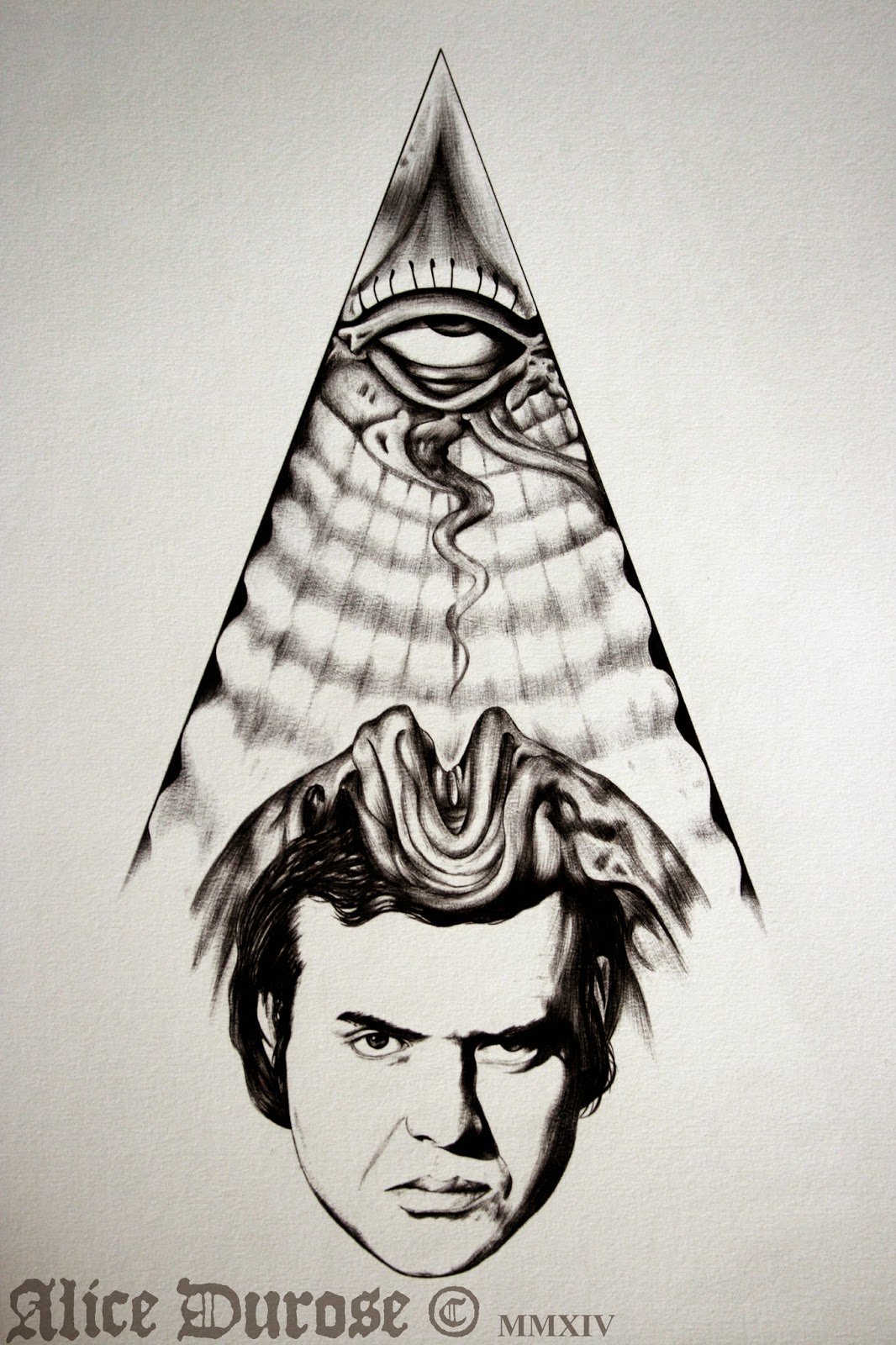
In my studio sits a portrait of Giger I drew a number of years ago. I see this everyday, and it is a constant reminder of Giger, his work, all that he has achieved, and all that can be achieved. It inspires and encourages me, every single day, and will continue to do so. For a number of years years I have been planning a Giger tattoo, and during the last 6 months I have drawn 4 different versions of the tattoo. I have completed a fifth design, with this portrait which is so important to me incorporated, as a true homage to my hero.

Giger has remained a constant inspiration, throughout my life. He has made me strive to new limits, to push forth towards his benchmark of perfection, to allow my creativity to take control and not feel restricted by conformity. Giger has, eventually, made me feel confident enough to draw what I really want to; what I feel and what I love, rather than what I think I should, and what society expects. He has changed my life in a way he will never know, and his legacy; his work, will continue to enrich my life, and the life of millions, forever.

Thank you, Hans Ruedi Giger.